Have you heard this one? How can you tell the difference between a good cryptography joke and a random string of words? You can’t—they’re indistinguishable under a chosen-plaintext attack (IND-CPA). Ba dum tss! Don’t get it? Sorry—something must have snapped inside me after Georgia Tech’s Applied Cryptography (CS 6260). My sense of humor is indecipherable now. Someone tell me if they find my lost keys. Bwah bwah bwah.
As good humored as I might sound now, the course itself was no joke. Conceptually, it pushed this lizard brain harder than any other class I’ve taken so far. I guess I’m not quite as “mathematically mature” as the prerequisites suggest. Don’t blame me—Jackson Chameleons have at best a 10-year life expectancy. I was born this way. That being said, hopefully I can offer a few good tips.
But before offering up advice, it’s worth starting with a simple definition of cryptography. Most of my readers are probably technical enough to skip this paragraph without a second thought, but I’m often surprised during everyday conversations by how fuzzy the concept can be. Part of that may be because the industry itself struggles to define cryptography without resorting to jargon. One of the simplest definitions I’ve found is Merriam-Webster’s: “secret writing.” That “secret” might be the message itself, proof that the message hasn’t been altered, assurance of who sent it—or all of the above. With that definition in mind, we can get back to the course.
Study better together. Or, if you prefer, remember “misery loves company”—pick your framing. Either way, forming or joining a homework group was invaluable. Unless you’re already a cryptography wizard who could practically write the textbook (yes, we had one of those), chances are you misunderstood something in the lectures or readings. More than one student felt confident about a homework, quiz, or exam submission only to have that confidence brutally dismantled weeks later when the delayed feedback finally arrived. Talking problems through with others has a way of flushing out bad ideas early while reinforcing the concepts that actually matter.
Take copious notes. Applied Cryptography’s exam-heavy format—with open-book and open-notes—can make the difference between passing and failing. In that regard, Obsidian performed spectacularly! It made organizing notes, lecture slides, and other course materials painless, and it also provides the LaTeX support needed for homework and exam submissions.
I entered this course underprepared and walked away with far more confidence. Don’t be misled by the word “applied” in the course title—CS 6260 is about learning the mathematical theory needed to evaluate cryptographic schemes, not implementing them. The underlying assumption is that cryptographic schemes and primitives will come and go, but the foundational principles that determine whether they are secure or insecure remain constant.
Professor Alexandra Boldyreva structures the semester naturally into two broad themes: symmetric and asymmetric cryptography. She begins by introducing the core goals of cryptography—confidentiality, integrity, and authenticity, and then slowly develops the tools needed for writing mathematical proofs. Much of modern cryptography isn’t about declaring something “secure” outright, but about defining what it would mean to break it. To do this, analysts construct theoretical attack games (such as the aforementioned IND-CPA), specifying the resources and capabilities granted to an attacker. A scheme is considered secure if no efficient adversary can win the game with more than negligible advantage. Different games model different threat scenarios, and often the strongest result one can hope for is that a scheme is indistinguishable from random.
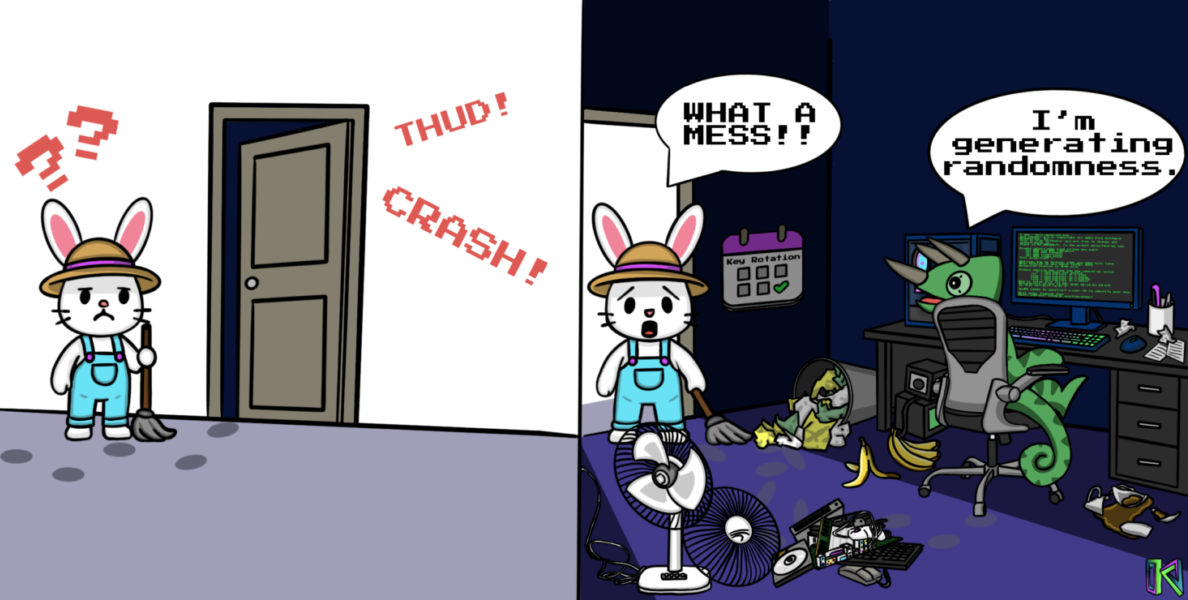
🎶 Hello random, my old friend. I’ve come to talk with you again. Because a vision—wait, where were we? The answer is 42. OK, so my brain is either on the fritz, or it’s just super secure. I guess the only thing separating us from the end of the world is an attacker’s computational limits. This leaves us with the existential threat of quantum computing, but from where I perch, we’ve got a ways to go before the quantum apocalypse. How come? I have a pretty innate sense of distance when my dinner depends on it. 🦗